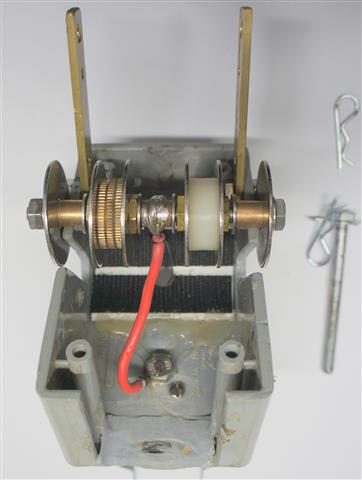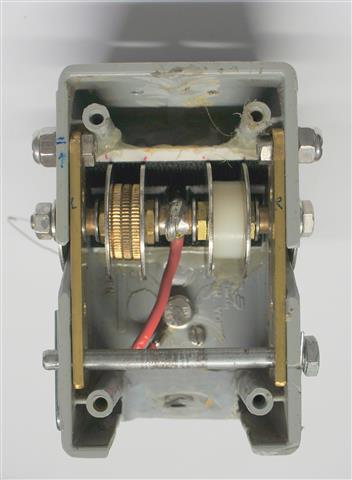
Wire is threaded from the Hi Grip drive pulley, up through the brass pulley.
Out toward the turnaround pulley to meet the insulating fiber line.
Over the turnaround pulley.
Back to the top of the nylon pulley.
Down the backside of the nylon pulley and down toward the Hi Grip drive pulley.
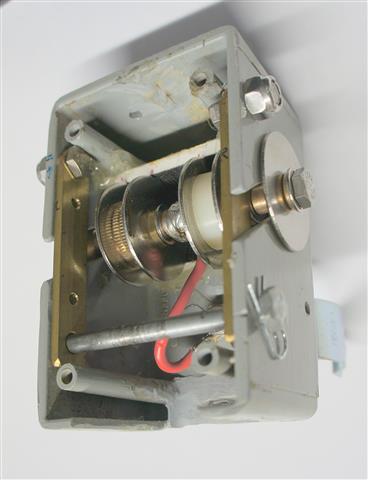
The center of the shaft is attaches to a spring which draws the pulley pair on an upward diagonal toward the back of the box.
At the back of the box the side members of the pulleys meet a curved section of PVC pipe which is covered with the “loop” part of hook and loop adhesive.
Wires are threaded through the pulleys but are prevented from jumping the pulleys by virtue of the mating on the pulley sides with the 90 degree pipe section.
When the Flagpole has been erected, applying light tension to the now horizontal wires brings the wires in contact with the pulley root diameters (one knurled brass, the other smooth nylon). As the wires are properly tensioned, the pulley shaft slides downward to the stop bars.